
What This Is: A complete system for building versatile microteams — from auditing your current skill gaps and mapping T-shaped profiles to hiring for breadth, cross-training existing members, and writing job descriptions that attract generalists. Designed to eliminate single points of failure and ship faster with fewer people.
warningWhy You Need This
Re-Logic built a $500M+ game with 11 people by hiring versatile generalists, not narrow specialists. While AAA game studios need 200+ employees, Re-Logic achieved 18x better efficiency by building a team where everyone could flex across multiple domains.
Single points of failure are the #1 risk for microteams. One person gets sick, takes vacation, or leaves — and critical work stops. This playbook shows you how to systematically eliminate that risk: audit what you have, map what you need, hire and train for breadth.
checklistWhat's Included
- chevron_right
Team Versatility Audit: Capability matrix, single-point-of-failure tracker, and Bottleneck Index calculator
- chevron_right
T-Shaped Skills Map: Depth/breadth/awareness template for every team member with a worked example
- chevron_right
Versatility Hiring System: 3 screening questions, a final interview structure, and a weighted scorecard
- chevron_right
90-Day Cross-Training Playbook: Week-by-week learning plan, goal-setting template, and quarterly rotation system
- chevron_right
Versatile Role Templates: 3 job descriptions optimized for generalists: Full-Stack Engineer, Founding Designer, Growth Generalist
timelinePlaybook Steps (In Order)
- counter_1
Step 1: Audit — Map your team's capabilities, find single points of failure, calculate your Bottleneck Index.
- counter_2
Step 2: Map — Fill out T-Shaped Skills Maps for every team member. Identify growth areas.
- counter_3
Step 3: Hire — Use the screening questions and scorecard for your next hire. Screen for breadth, not just depth.
- counter_4
Step 4: Train — Run 90-day cross-training plans to expand existing team skills. Rotate quarterly.
- counter_5
Step 5: Design — Write versatile job descriptions using the 3 templates. Attract generalists from the start.
searchStep 1: Team Versatility Audit
A 3-part audit: map who can do what on your team, identify every single point of failure, and calculate your Bottleneck Index to see how fragile (or resilient) your team really is.
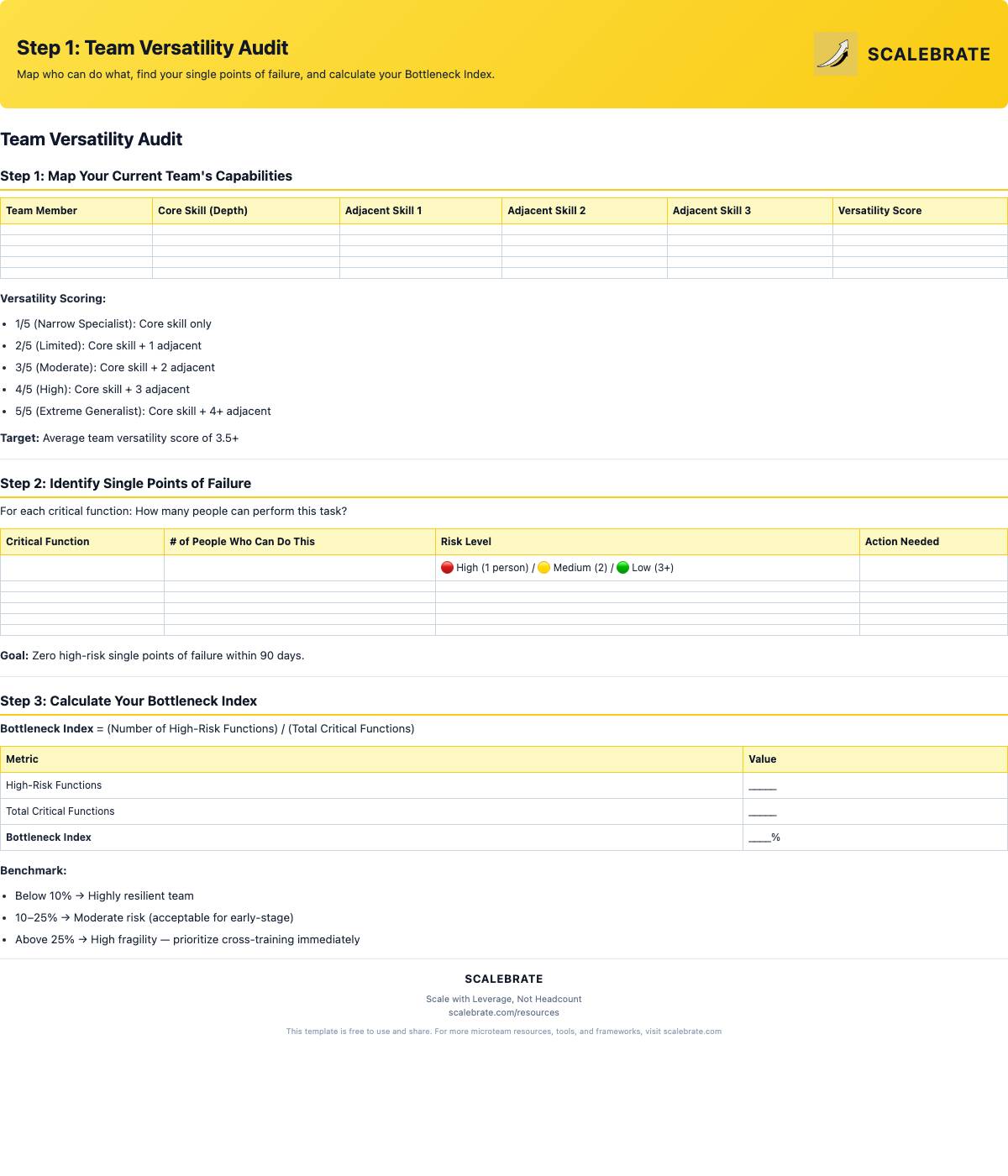
Capability matrix, single-point-of-failure risk table, and Bottleneck Index calculator.
personStep 2: T-Shaped Skills Map
Document each team member's depth, breadth, awareness, and growth areas on a structured template. Includes a fully worked example of a T-shaped backend engineer to set the standard.
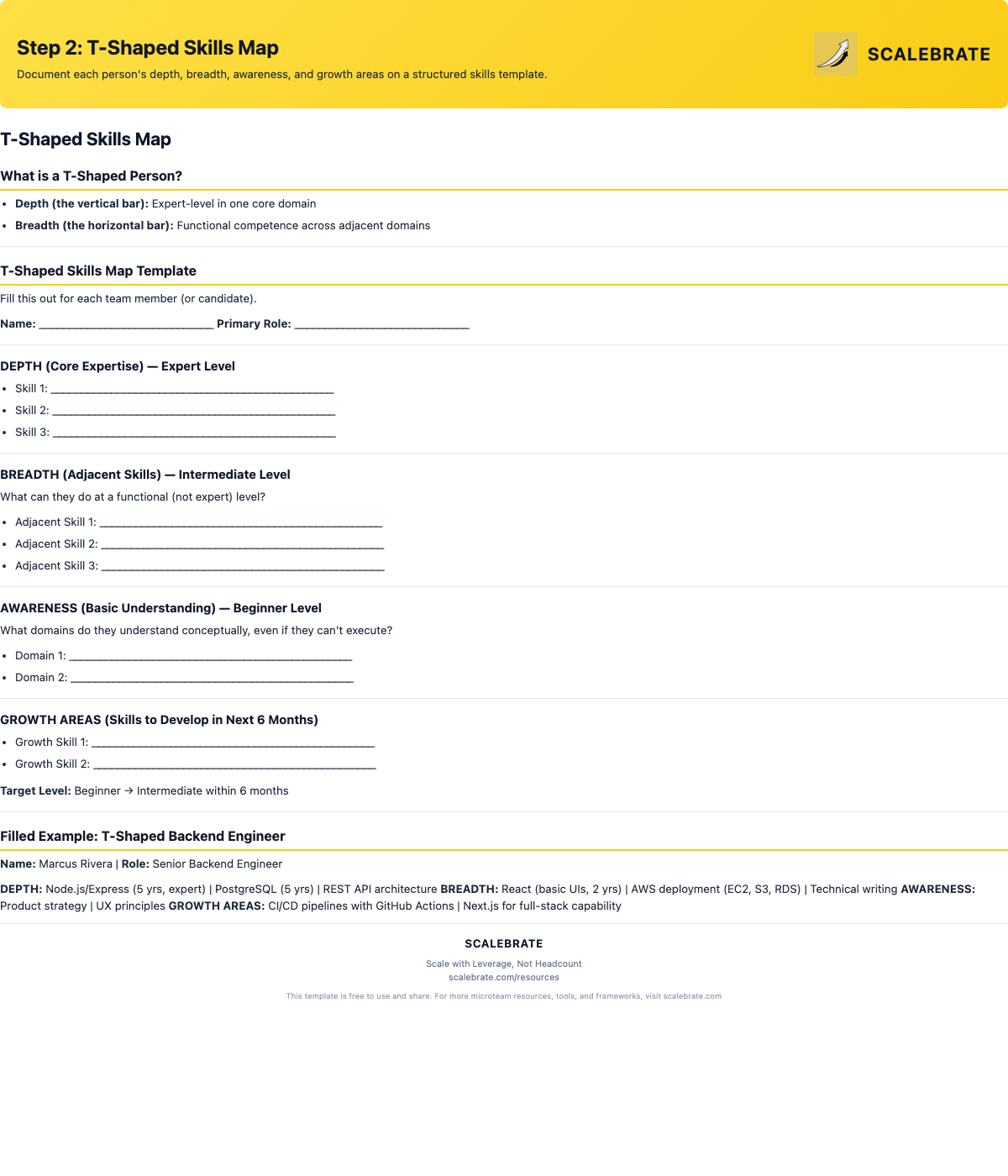
Depth/breadth/awareness template plus a filled example and growth area planning section.
interview_roundStep 3: Versatility Hiring System
3 screening questions that filter for breadth (cross-functional work, learning velocity, end-to-end ownership), a 4-segment final interview structure, and a weighted scorecard with a clear hire/pass threshold.
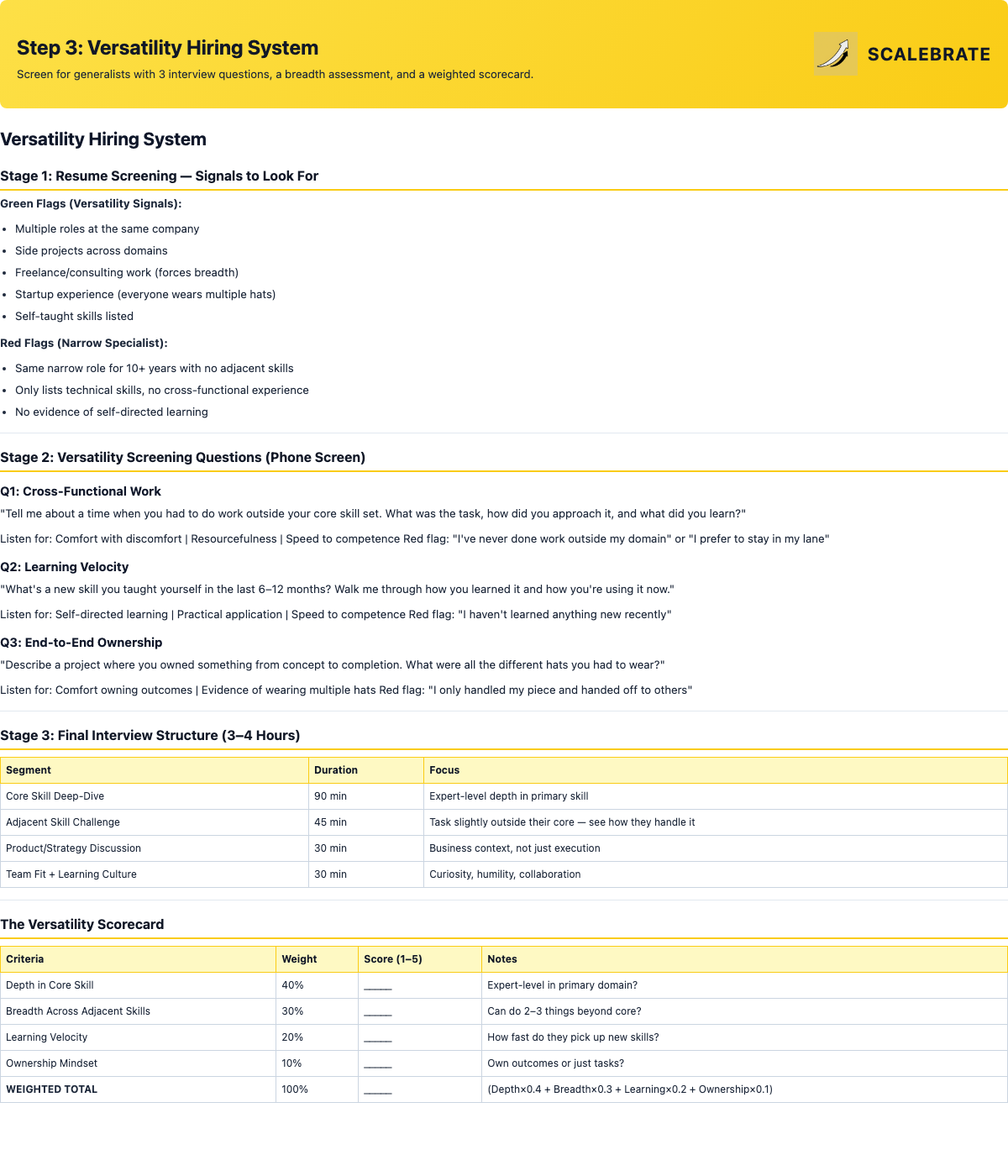
Screening questions with example answers, interview structure, and a weighted scorecard.
schoolStep 4: 90-Day Cross-Training Playbook
A week-by-week plan to take each team member from beginner to intermediate in one adjacent skill. Includes common role/skill pairings, a learning schedule, a progress assessment, and a quarterly rotation system.
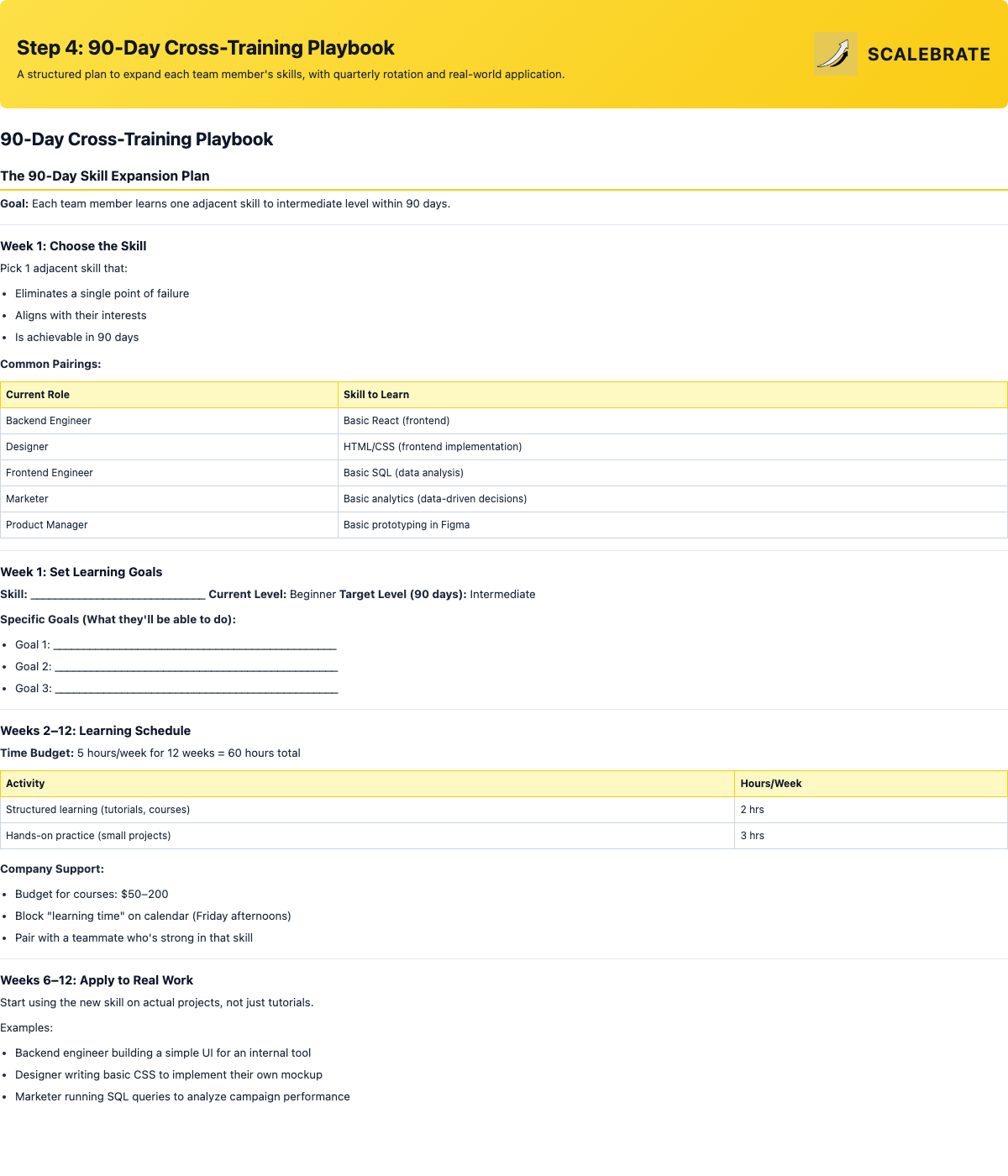
Goal-setting template, 12-week learning schedule, real-work application guide, and progress checklist.
descriptionStep 5: Versatile Role Design Templates
3 fill-in-the-blank job descriptions built for generalists — Full-Stack Engineer, Founding Designer, and Growth Generalist. Each separates core skills (depth) from adjacent skills (breadth) and sets the right mindset expectations.
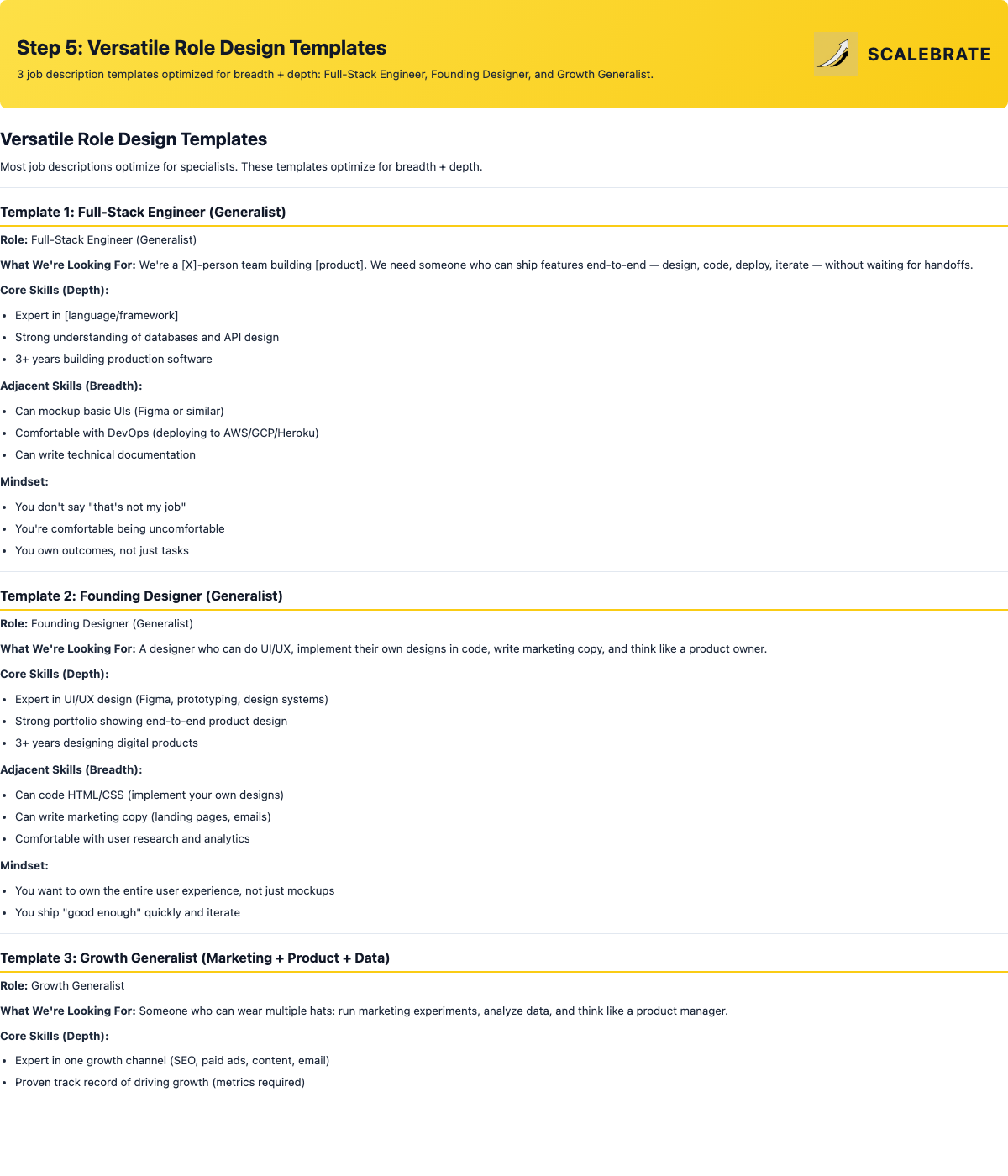
3 generalist job description templates with depth, breadth, and mindset sections.
Tip 1: Pay Versatile People More — A person who can design + code + write is replacing 3 people. Pay them like it. Attracts top talent and retains versatile employees.
Tip 2: Celebrate Breadth, Not Just Depth — "Carlos designed, coded, tested, and shipped the checkout flow solo in 3 days. That's the versatility we need."
Tip 3: Make "Learning New Skills" Part of Reviews — Add: "What's one adjacent skill you learned this quarter? How did you apply it?" Makes versatility a cultural expectation.
Tip 4: The Bus Factor Test — For every critical function, ask: "If this person got hit by a bus tomorrow, could we still operate?" If no, you have a single point of failure. Fix it within 90 days.