
What This Is: A 4-step playbook extracted from ConcernedApe's journey building Stardew Valley solo to $500M in revenue — with 7 actionable principles, a Learn vs. Outsource framework, a 5-phase product roadmap, and financial planning templates. Designed to show solo founders how to build something exceptional without burning out or giving up control.
warningWhy You Need This
Eric Barone spent 4+ years building Stardew Valley alone — no team, no investors, no shortcuts. The result: over $500M in revenue and one of the most beloved games ever made. His approach challenges everything conventional wisdom says about building fast.
This playbook translates his 7 core principles into actionable frameworks for solo founders and microteams. Whether you're building software, content, or a creative product, it shows you how to go slow, go deep, and build something that lasts — while staying profitable and avoiding burnout.
checklistWhat's Included
- chevron_right
Quality Pillars Worksheet — Define what "great" means for your product and close the gaps
- chevron_right
Ownership Decision Matrix — Solo vs. co-founder vs. investor-backed trade-offs at a glance
- chevron_right
Learn vs. Outsource Framework — Decide which skills to acquire and which to hire out, with a skill acquisition plan template
- chevron_right
3-Phase Community Building Timeline — Pre-launch, beta, and launch engagement strategy with platform and frequency guides
- chevron_right
Sustainable Pace Framework — Rules for deep work, recovery, and a burnout warning checklist
- chevron_right
Pricing Strategy Decision Matrix — Pick the right pricing model based on your goals and market
- chevron_right
5-Phase Solo Product Roadmap — Foundation → Deep Work → Polish → Launch → Sustain with milestone checkpoints
- chevron_right
Financial Model Template — Phase-by-phase cost planning with 5 funding options ranked by risk
timelinePlaybook Steps (In Order)
- counter_1
Step 1: Core Principles — Craft, Ownership & Learn vs. Outsource — Master the first 3 principles with worksheets and decision frameworks.
- counter_2
Step 2: Build in Public, Sustainable Pace, Pricing & Long-Term Thinking — Apply principles 4–7 with a community timeline, pace framework, and pricing matrix.
- counter_3
Step 3: The Solo Creator Product Roadmap — Map your 5-phase journey from idea to sustainable business with milestone checkpoints.
- counter_4
Step 4: Financial Planning, Funding Options & When Solo Doesn't Work — Model your costs, choose funding wisely, and know when it's time to scale.
starStep 1: Core Principles — Craft, Ownership & Learn vs. Outsource
The first 3 principles from ConcernedApe's playbook: define your Quality Pillars and ship-readiness criteria, decide solo vs. partner with the Ownership Matrix, and map out which skills to learn vs. outsource with a Skill Acquisition Plan.
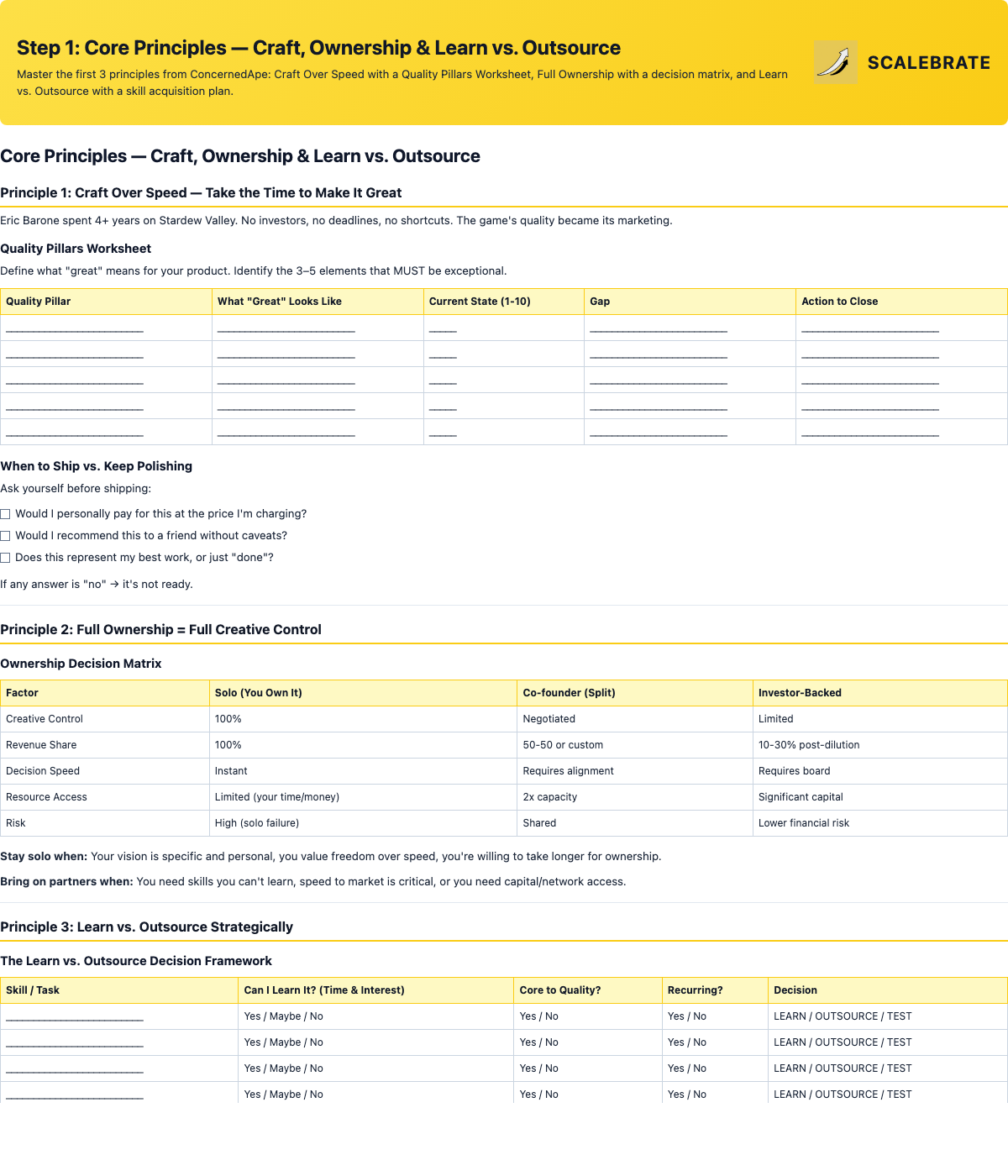
Quality Pillars Worksheet, ship vs. polish checklist, Ownership Matrix, Learn vs. Outsource framework, and Skill Acquisition Plan.
publicStep 2: Build in Public, Sustainable Pace, Pricing & Long-Term Thinking
A 3-phase community building timeline with platform and frequency guides, a sustainable pace framework with a burnout warning checklist, a pricing strategy decision matrix, and a long-term maintenance commitment framework.
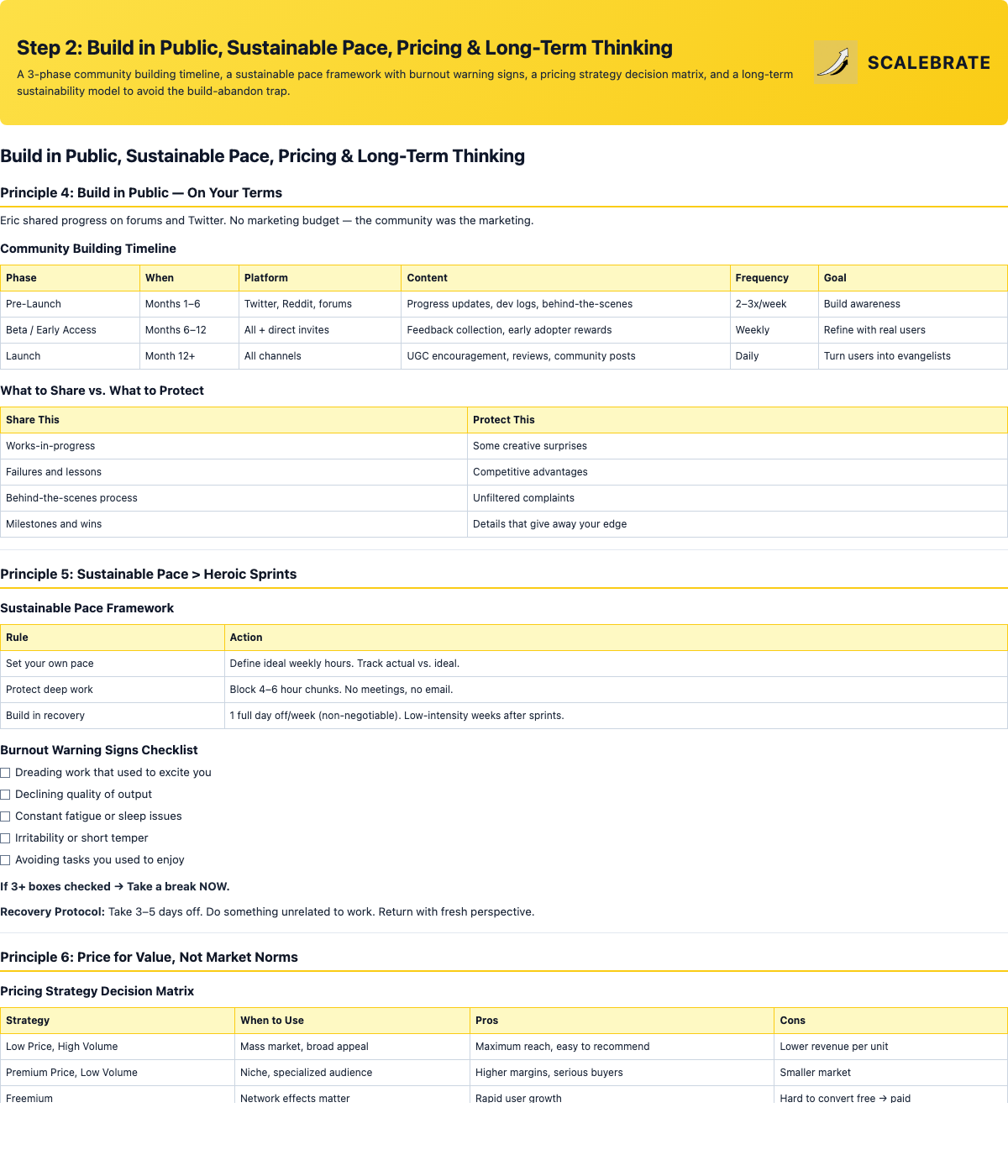
Community timeline, share vs. protect guide, burnout checklist, pricing matrix, 10-year test, and maintenance framework.
rocket_launchStep 3: The Solo Creator Product Development Roadmap
A 5-phase roadmap from Foundation through Sustain, with task checklists and milestone checkpoints for each phase, plus a progress tracker to keep your solo journey on track.
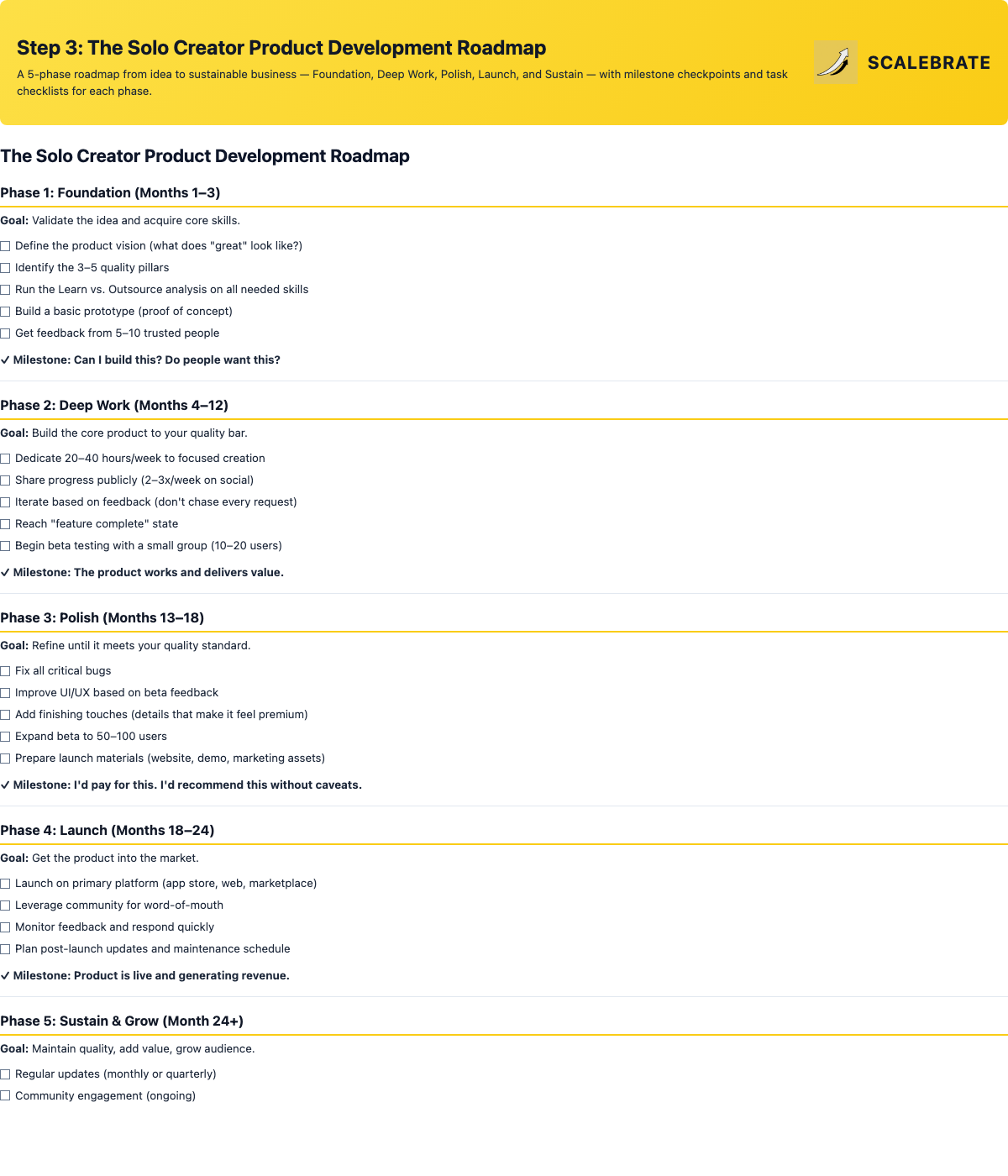
5-phase roadmap with task checklists, milestone checkpoints, and a progress tracker with status and blocker fields.
calculateStep 4: Financial Planning, Funding Options & When Solo Doesn't Work
A phase-by-phase financial model template with a 20–30% buffer rule, 5 funding options ranked by risk, a warning-signs checklist for when you need a team, and a solo vs. team decision worksheet.
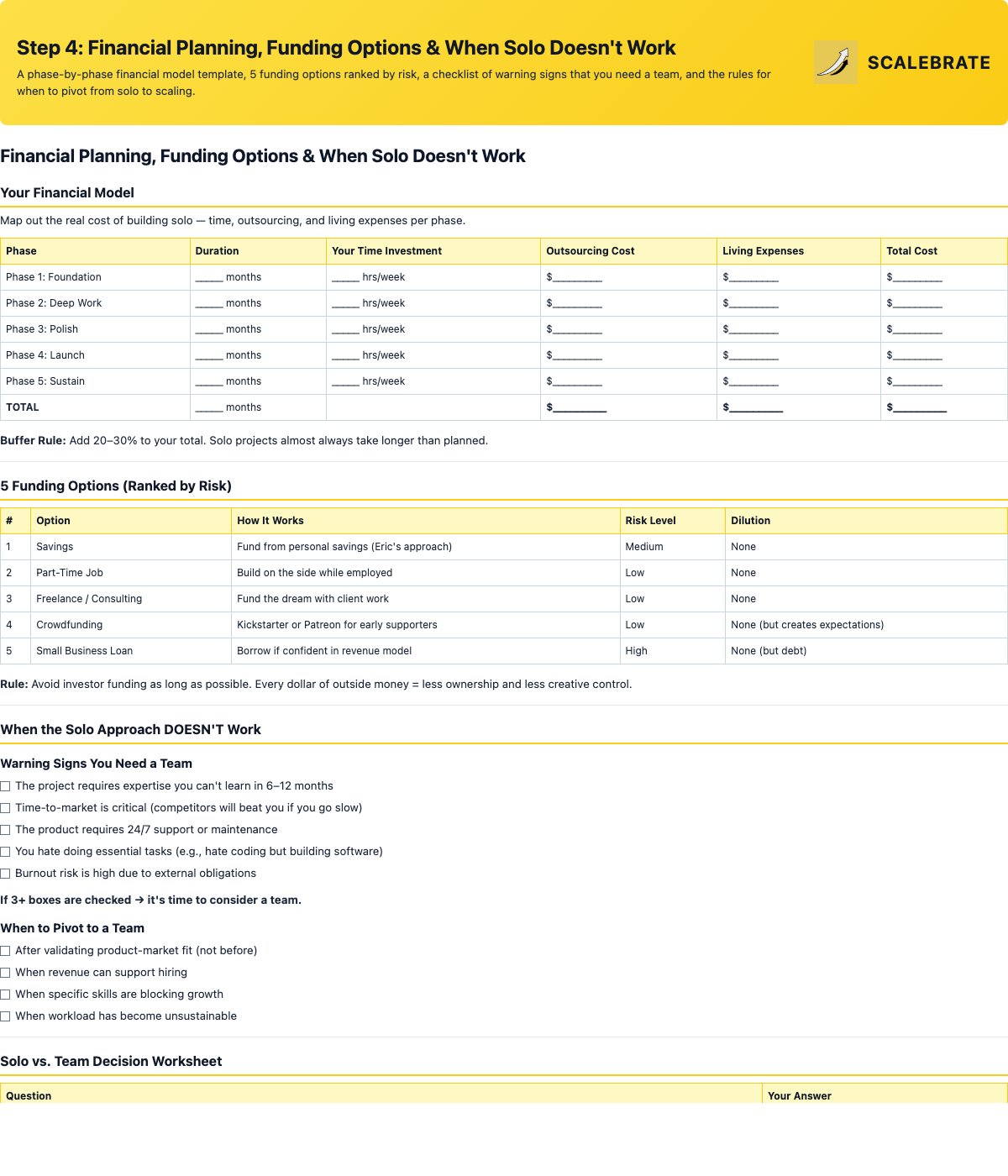
Phase-by-phase cost model, 5 funding options ranked by risk, team warning signs checklist, and a solo vs. team decision worksheet.
Tip 1: Validate Before You Build Deep — Don't spend 8 months in Deep Work before confirming people want it. Phase 1 exists to answer that question cheaply.
Tip 2: Ship the Prototype, Not the Dream — A working prototype with 3 features beats a perfect product that's still in your head. Feedback is your fastest path to quality.
Tip 3: Your Community Is Your Marketing Budget — Build in public from day 1. Every dev log, every behind-the-scenes post is free marketing that compounds over time.
Tip 4: Maintenance Is a Feature, Not a Burden — The products that last are the ones people know will still be there in 2 years. Committing to maintenance is a competitive advantage.