
What This Is: A 3-part toolkit to define, document, and defend your microteam identity. Includes a fill-in-the-blank manifesto, 5 operating principles, an efficiency playbook, stakeholder communication guides, and a 10-question hiring filter that protects your lean model from premature growth.
warningWhy You Need This
Being a microteam isn't just staying small — it's a strategic choice with real competitive advantages. But without language to defend it, you'll face constant pressure to "scale up like a real company." Clients, candidates, and investors will all question your model.
This toolkit gives you the frameworks, templates, and proof points to articulate your microteam philosophy with confidence — and a filter that stops premature hiring before it dilutes your efficiency.
lightbulbHow to Use This Toolkit
- counter_1
Write Your Manifesto: Use Part 1 to craft your philosophy and document the 5 operating principles that govern how your team works.
- counter_2
Log Your Efficiency Tactics: Part 2's playbook templates capture the specific moves that let you compete with 10x larger teams.
- counter_3
Prepare Talking Points: Part 2 includes copy-paste communication guides for clients, recruits, and investors — every stakeholder covered.
- counter_4
Protect the Model: Before any hire, run Part 3's 10-question filter. If you can't pass all 10, the answer is "not yet."
edit_notePart 1: Manifesto Template & Operating Principles
A fill-in-the-blank manifesto template that gives your microteam a clear, shareable philosophy — plus 5 operating principles (automation-first, leverage metrics, A-players, async-first, systems over heroes) with frameworks to document how your team makes decisions.
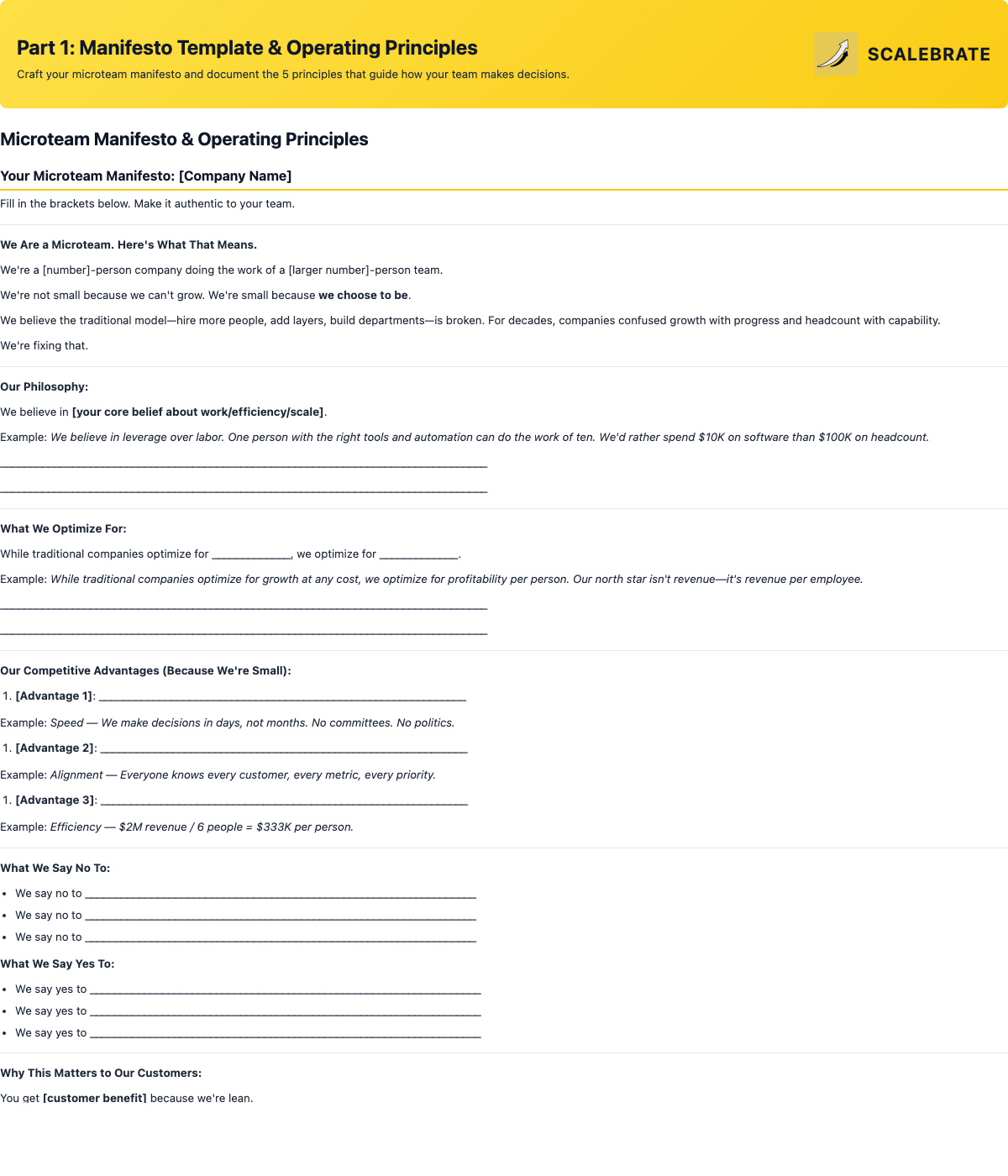
Fill-in-the-blank manifesto with philosophy, advantages, and commitments — plus 5 documented operating principles.
lightbulbPart 2: Efficiency Playbook & Stakeholder Guides
Log the high-leverage tactics that let you compete with 10x larger teams — with room for 5+ custom entries. Paired with copy-paste communication scripts for clients (why we're faster), candidates (why join us), and investors (why we stay lean).
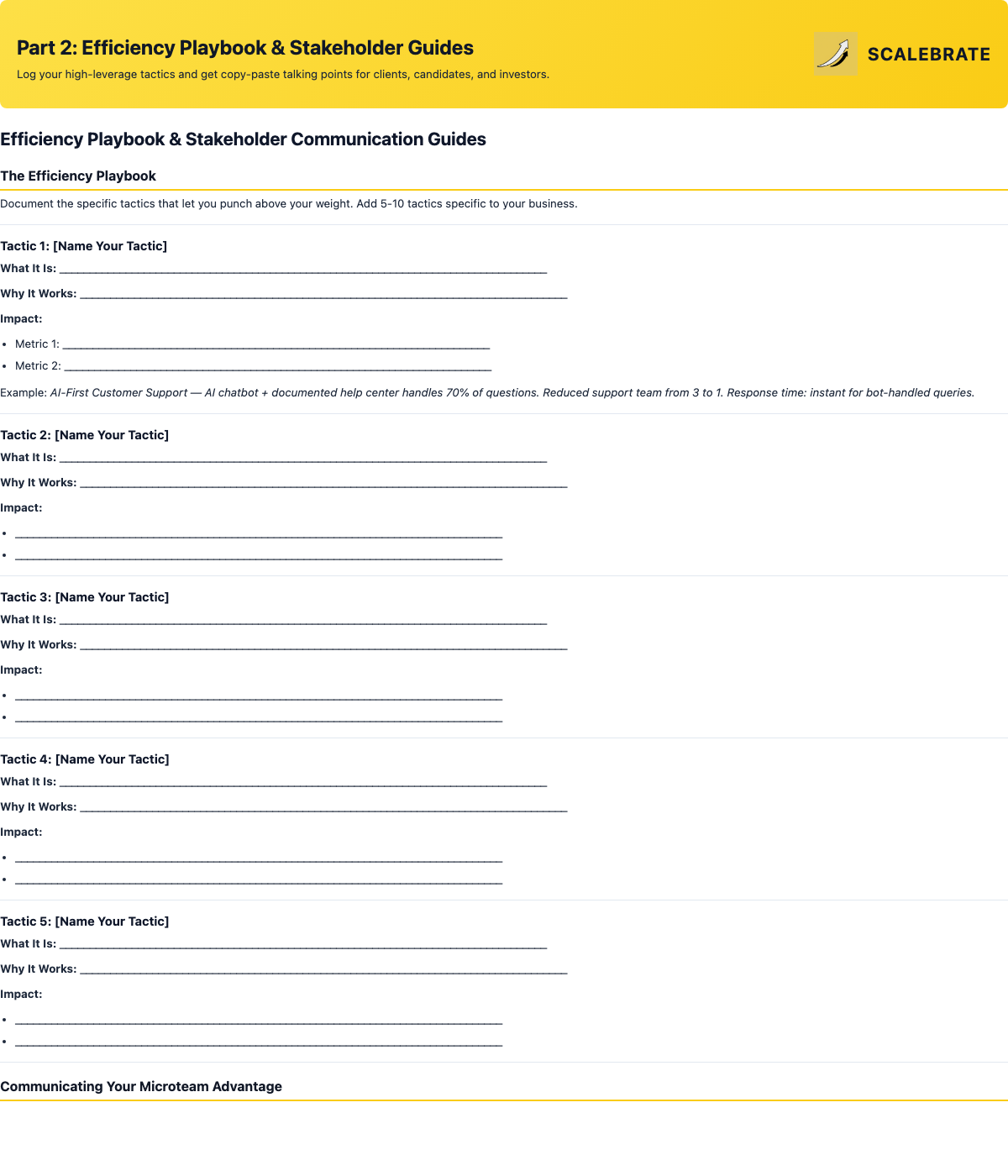
5 tactic templates with impact metrics and 12 stakeholder talking points across clients, candidates, and investors.
person_addPart 3: The "Should We Hire?" Decision Framework
A 10-question hiring filter that forces rigorous analysis before committing to any role. Includes an RPE reality check to test whether the hire dilutes your efficiency, plus a case study reference table showing how Basecamp, MailChimp, and Instagram achieved billion-dollar outcomes with tiny teams.
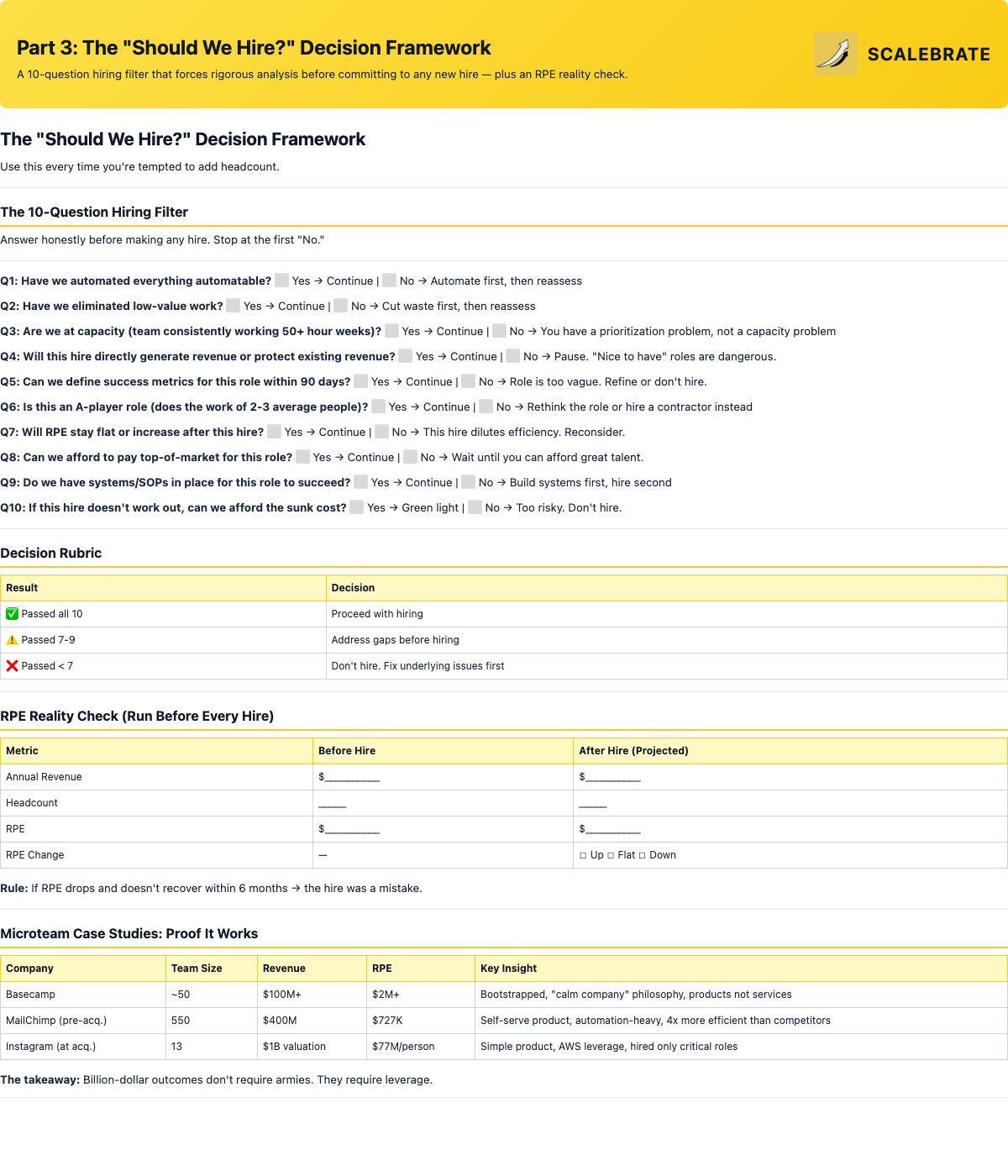
10-question filter, decision rubric, RPE reality check, and a microteam case study comparison table.
Tip 1: Publish Your Manifesto — Put it on your website and share it with prospects. It's a differentiator and a filter — attracts people who value efficiency, repels people who want traditional corporate structures.
Tip 2: Revisit Annually — Your manifesto should evolve. Review it every year and update based on what you've learned about operating as a microteam.
Tip 3: Use It in Decision-Making — When someone says "we should hire," pull out the manifesto. Does this hire align with your principles? If not, don't do it.
Tip 4: Make It Part of Onboarding — New hires should read and discuss the manifesto during onboarding. It sets expectations and reinforces your operating model from day one.