
What This Is: A complete system for scaling capacity without adding headcount. The 6-tier decision tree forces you to eliminate, automate, systematize, outsource, and use fractional help before considering a full-time hire — with frameworks, calculators, and templates at every stage. Designed to save $40K–60K per avoided hire.
warningWhy You Need This
Every full-time hire adds $75K+/year in fixed costs, coordination overhead, and management burden. For microteams, that's not just money — it's a structural shift that slows you down.
Most founders hire because it feels like progress. But headcount isn't progress. Output is progress. This playbook forces you to exhaust every cheaper, faster alternative — automation, outsourcing, fractional help — before committing to full-time headcount. Most bottlenecks don't need a hire. They need a system.
checklistWhat's Included
- chevron_right
Bottleneck Analysis Framework: Map constraints, classify by type, and calculate the cost of leaving each one unsolved
- chevron_right
6-Tier Decision Tree: Eliminate → Automate → Systematize → Outsource → Fractional → Hire — with decision criteria at every tier
- chevron_right
Automation Opportunity Audit: Score recurring tasks, match them to tools, and calculate ROI
- chevron_right
Process Documentation SOP Template: Systematize any task so it can be delegated to a VA, AI, or junior person
- chevron_right
Role Conversion Framework: 4 alternatives to test before you post a job listing
timelinePlaybook Steps (In Order)
- counter_1
Step 1: Identify Bottlenecks — Map what's blocking growth, classify each by type, and quantify the cost of leaving it unsolved.
- counter_2
Step 2: Run the Decision Tree — For each bottleneck, climb from Eliminate to Hire. Stop as soon as you solve it.
- counter_3
Step 3: Audit for Automation — Find every task that software can handle. Score, match to tools, calculate ROI.
- counter_4
Step 4: Document and Convert — Systematize processes with the SOP template. Before hiring, test all 4 conversion options.
analyticsStep 1: Bottleneck Analysis Framework
A 3-step framework to identify your top capacity constraints, classify them as Volume / Expertise / Time / Complexity, and calculate the monthly cost of leaving each one unsolved — which becomes your budget for solving it.
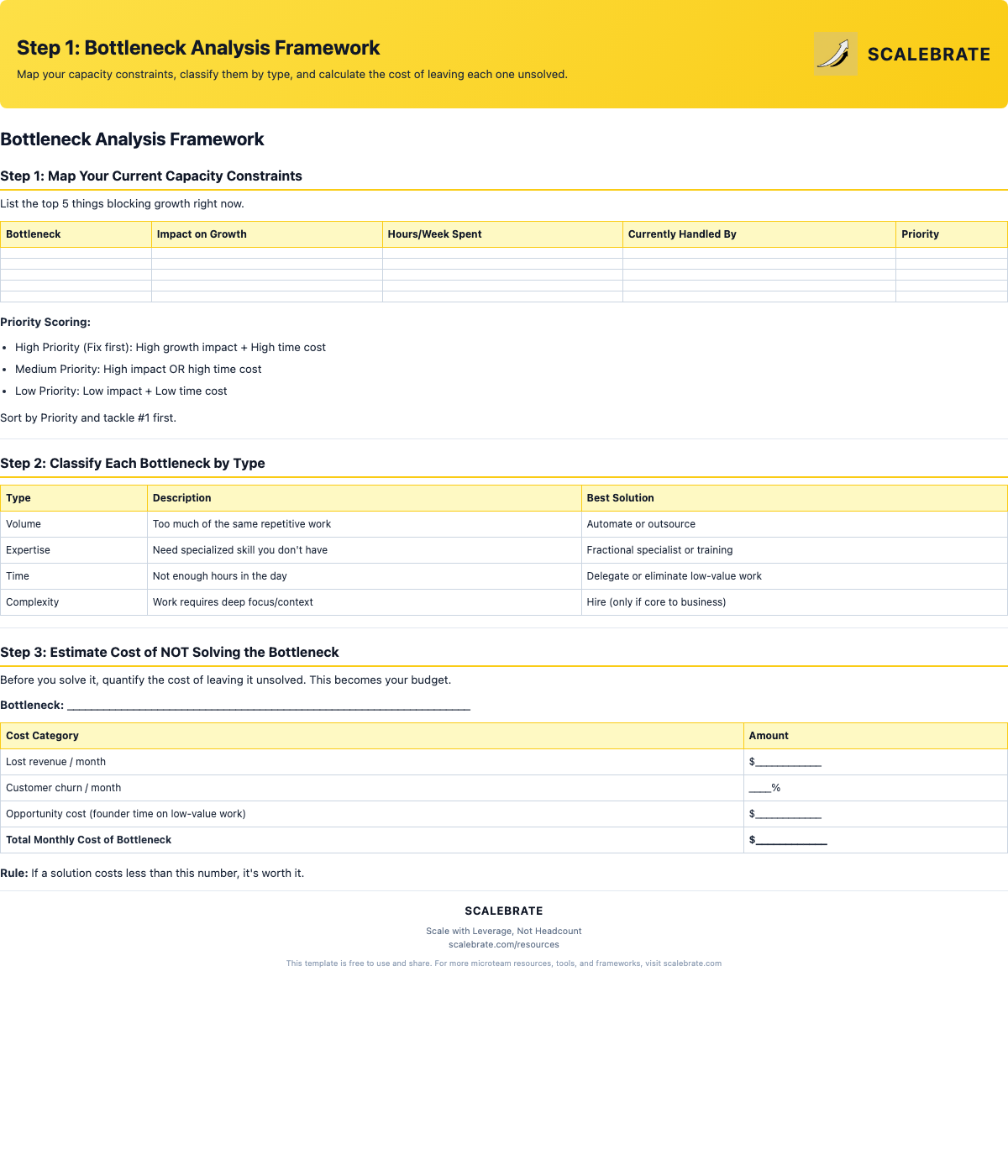
Constraint identification matrix, type classification table, and cost-of-inaction calculator.
device_hubStep 2: The 6-Tier Decision Tree
The core of the playbook: a structured decision tree that forces you through Eliminate → Automate → Systematize → Outsource → Fractional → Hire. Each tier has decision criteria, common tactics, and an automation ROI calculator. You only hire when every other option is genuinely exhausted.
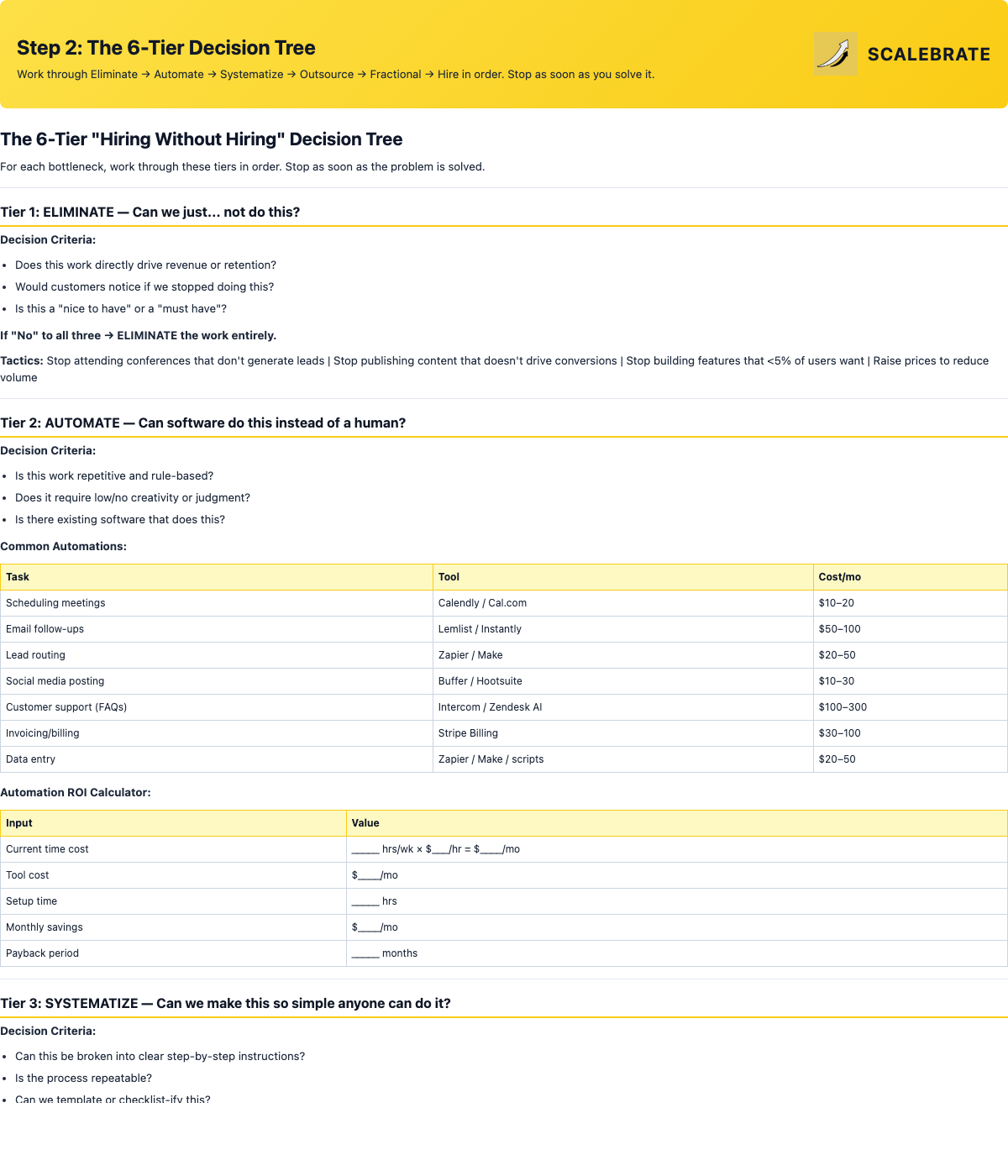
6 tiers with decision criteria, automation tool table, outsourcing directory, and the full-time hire checklist.
buildStep 3: Automation Opportunity Audit
A 4-step audit to find every task that software can handle: list recurring work, score it on repetitiveness/rule-based/volume, match high-scoring tasks to specific tools, and calculate ROI to decide which automations to build first.
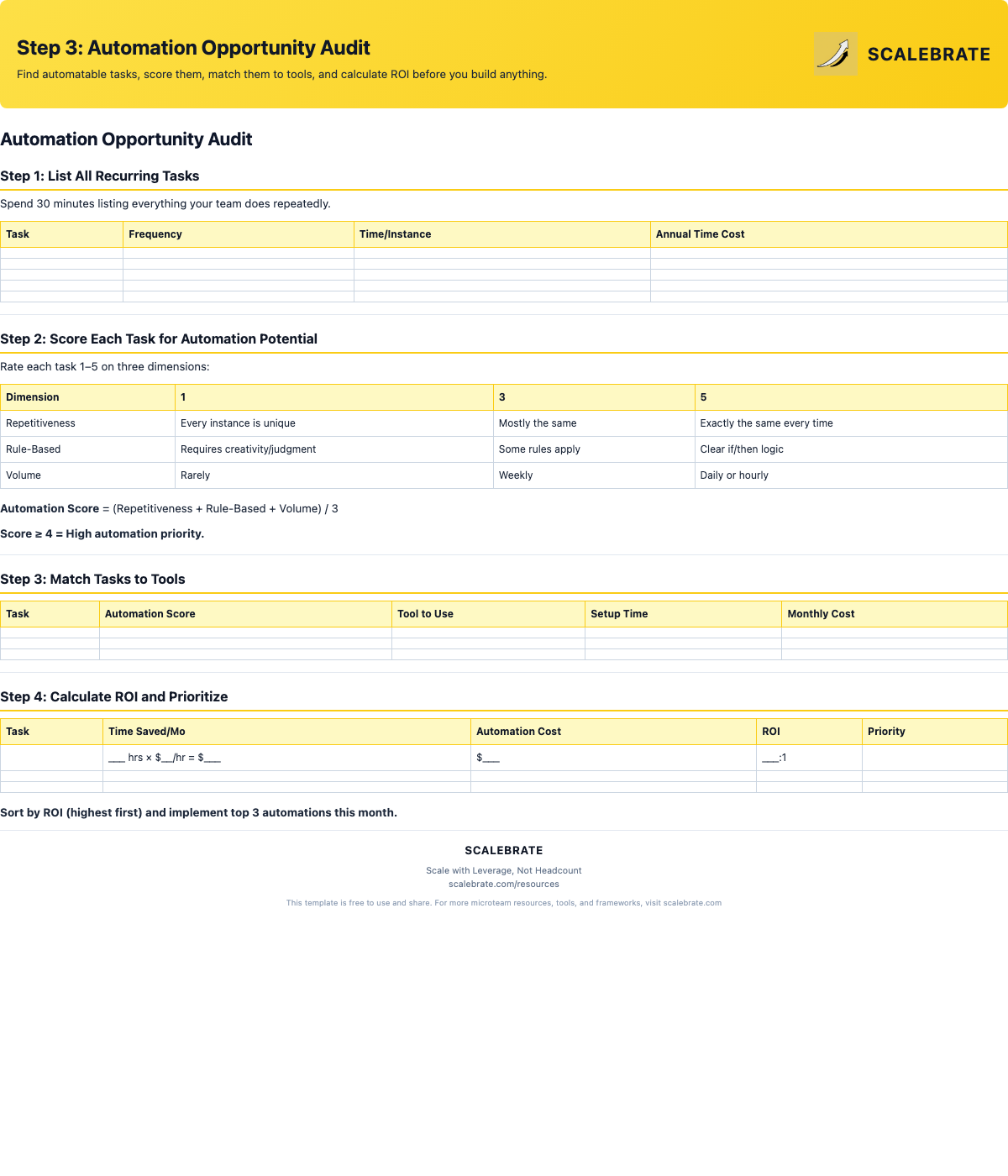
Task inventory, 3-dimension scoring matrix, tool matching table, and ROI prioritization grid.
descriptionStep 4: Process Documentation & Role Conversion
Two templates in one: a full SOP template that turns any recurring task into a documented, delegatable process — and a Role Conversion Framework that tests 4 alternatives (automation + QA, productized service, fractional specialist, upskilling) before you post a job listing.
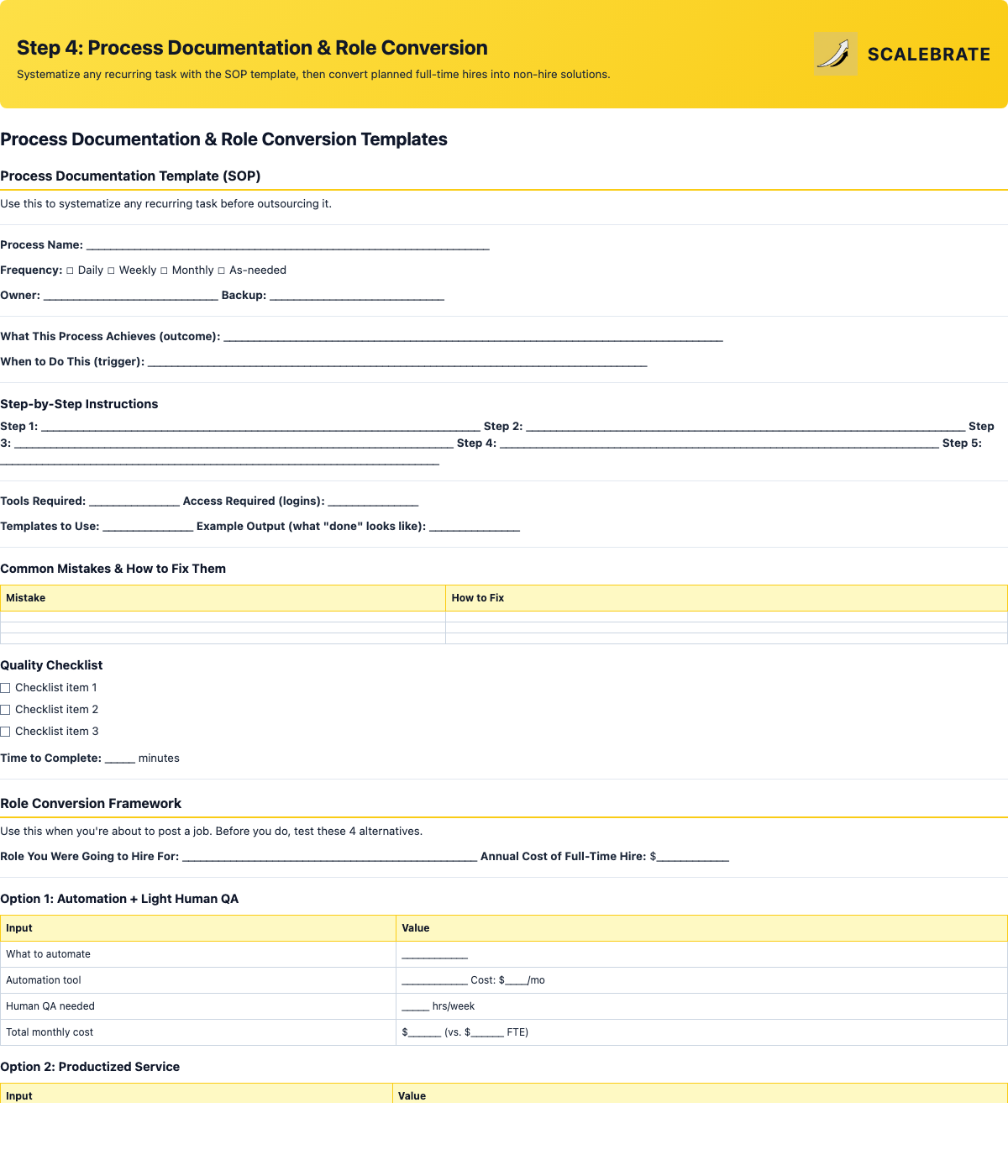
SOP template with steps, tools, and quality checklist, plus the 4-option role conversion comparison.
Tip 1: The "2-Week Test" Rule — Before hiring full-time, test the alternative for 2 weeks. Try a VA. If it doesn't work, move to fractional. Then hire. Most problems get solved before you reach "hire."
Tip 2: Start with "AI + Human QA" — AI handles the first 80% of the work. A human (you or a VA) QAs the final 20%. 10x output without 10x headcount.
Tip 3: Build a "No-Hire Budget" — Set a monthly budget ($2,000) for automation tools, VAs, and contractors. Forces you to explore creative solutions before defaulting to headcount.
Tip 4: Celebrate "Hires Avoided" — Track how many roles you didn't hire for because you found an alternative. "This year we avoided 3 hires. Saved $180K." Makes "hiring without hiring" a cultural win.