
What This Is: A complete system for running rapid product and growth experiments with a backlog, ICS prioritization, experiment templates, and a results tracker to capture learnings.
warningWhy You Need This
Building features based on gut feel is a gamble. Most features fail because you learn they are wrong after weeks or months of work.
This playbook lets you test ideas in days, measure results objectively, and double down only on what works.
checklistHow to Use This System
- counter_1
Capture Ideas in the Backlog: Every idea starts with a hypothesis.
- counter_2
Prioritize with ICS: Rank by Impact, Confidence, and Speed.
- counter_3
Design Experiments: Define metrics and the minimum viable test before building.
- counter_4
Run Experiments Weekly: Ship small tests every week, not big bets every quarter.
- counter_5
Log Results: Capture learnings and update your backlog based on evidence.
timelinePlaybook Steps (In Order)
- counter_1
Step 1: Experiment Types (Guide) - Choose the right test before building.
- counter_2
Step 2: Experiment Design (Template) - Define hypothesis, metrics, MVT, and decision criteria.
- counter_3
Step 3: Experiment Backlog & ICS Prioritization (Template) - Capture and score every idea, including the ICS guide.
- counter_4
Step 4: Experiment Results Tracker (Template) - Log outcomes and learnings.
- counter_5
Step 5: Weekly Experiment Rhythm (Guide) - Plan Monday, review Friday, repeat.
categoryExperiment Types & Examples
Choose the right test before you commit engineering time.
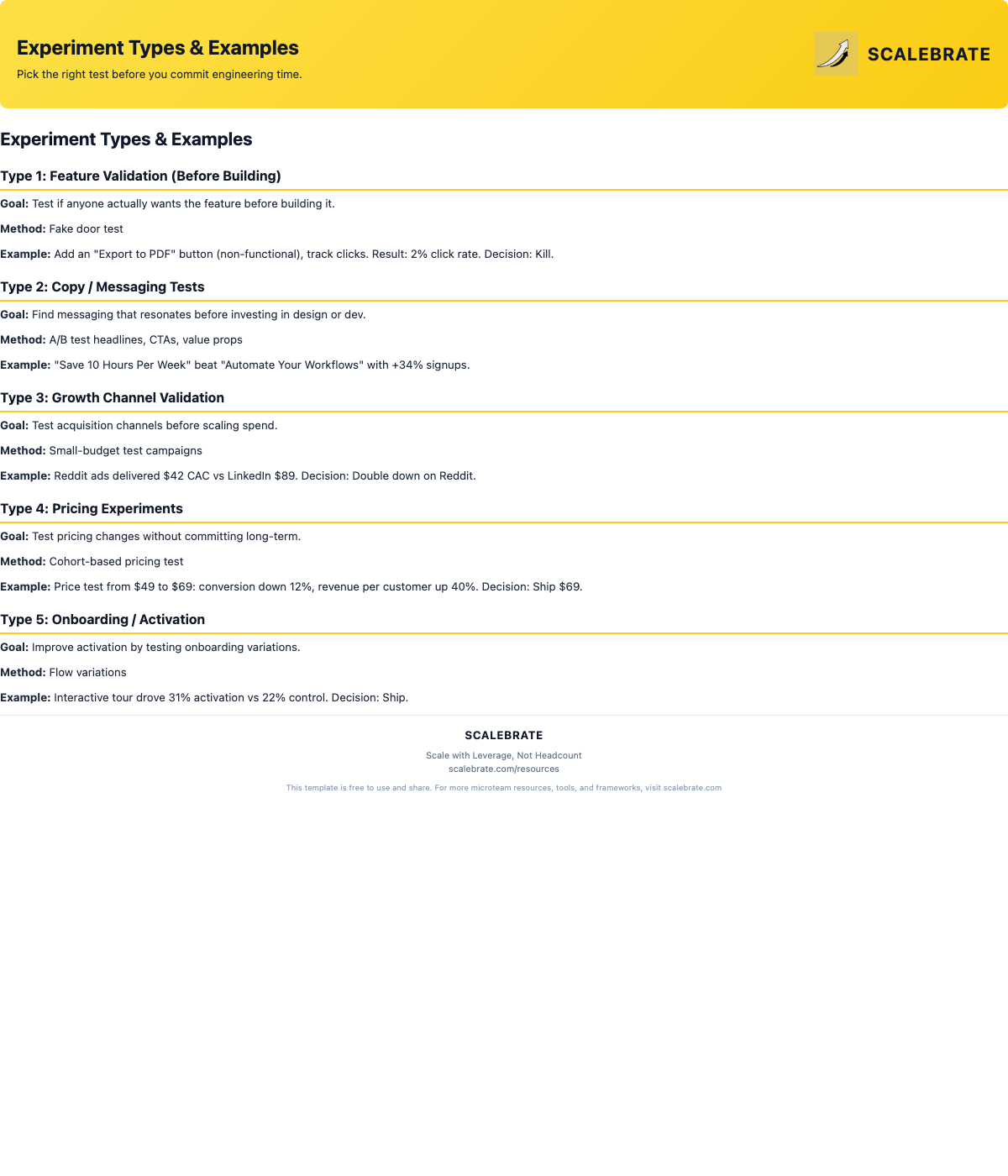
Download for the full experiment type catalog and examples.
lab_profileExperiment Design Template
Define hypothesis, success metrics, MVT, and decision criteria before you build.
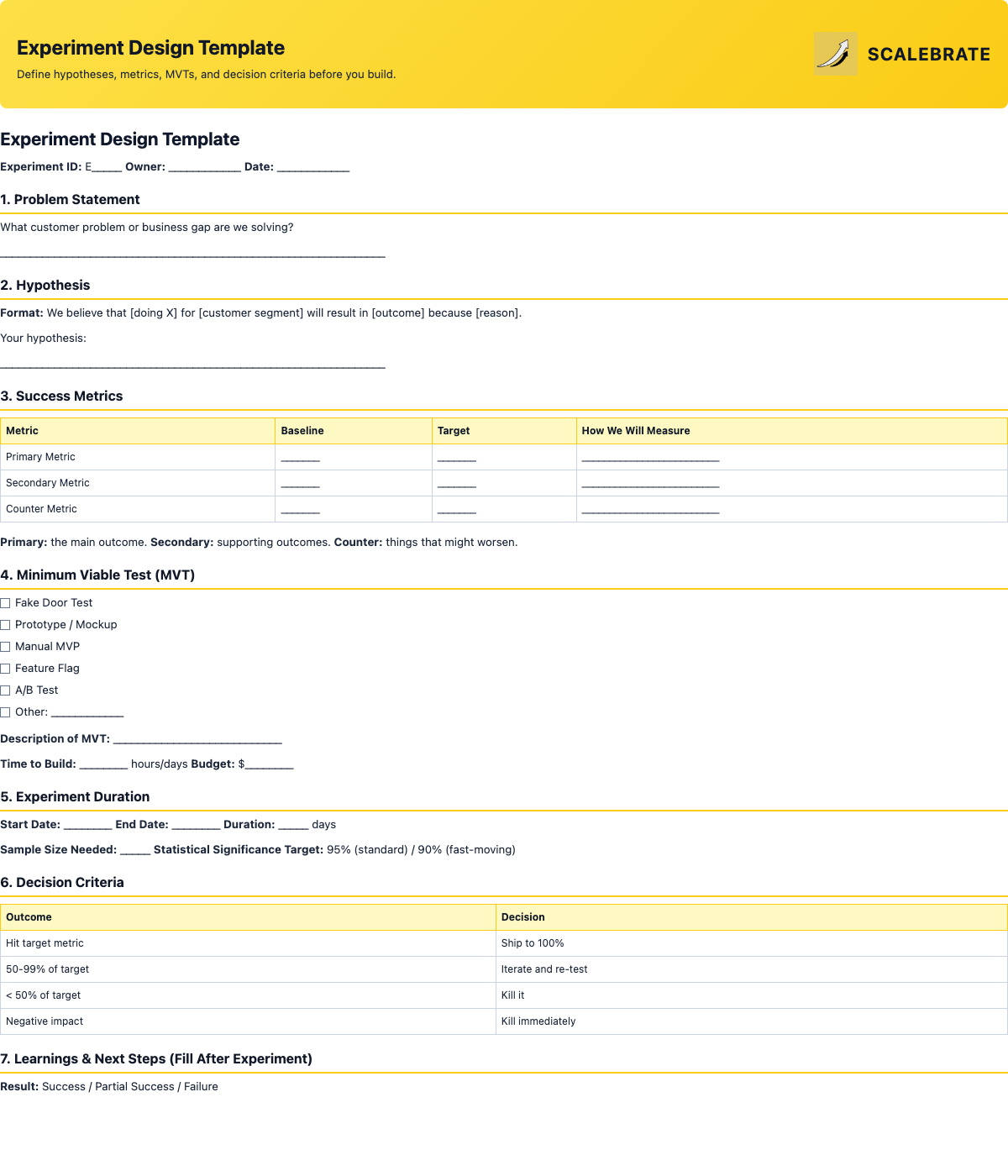
Use this template to define hypotheses, metrics, and decision criteria.
dashboardExperiment Backlog & ICS Prioritization
Use this backlog template to capture every idea, then score it with ICS to prioritize experiments fast.
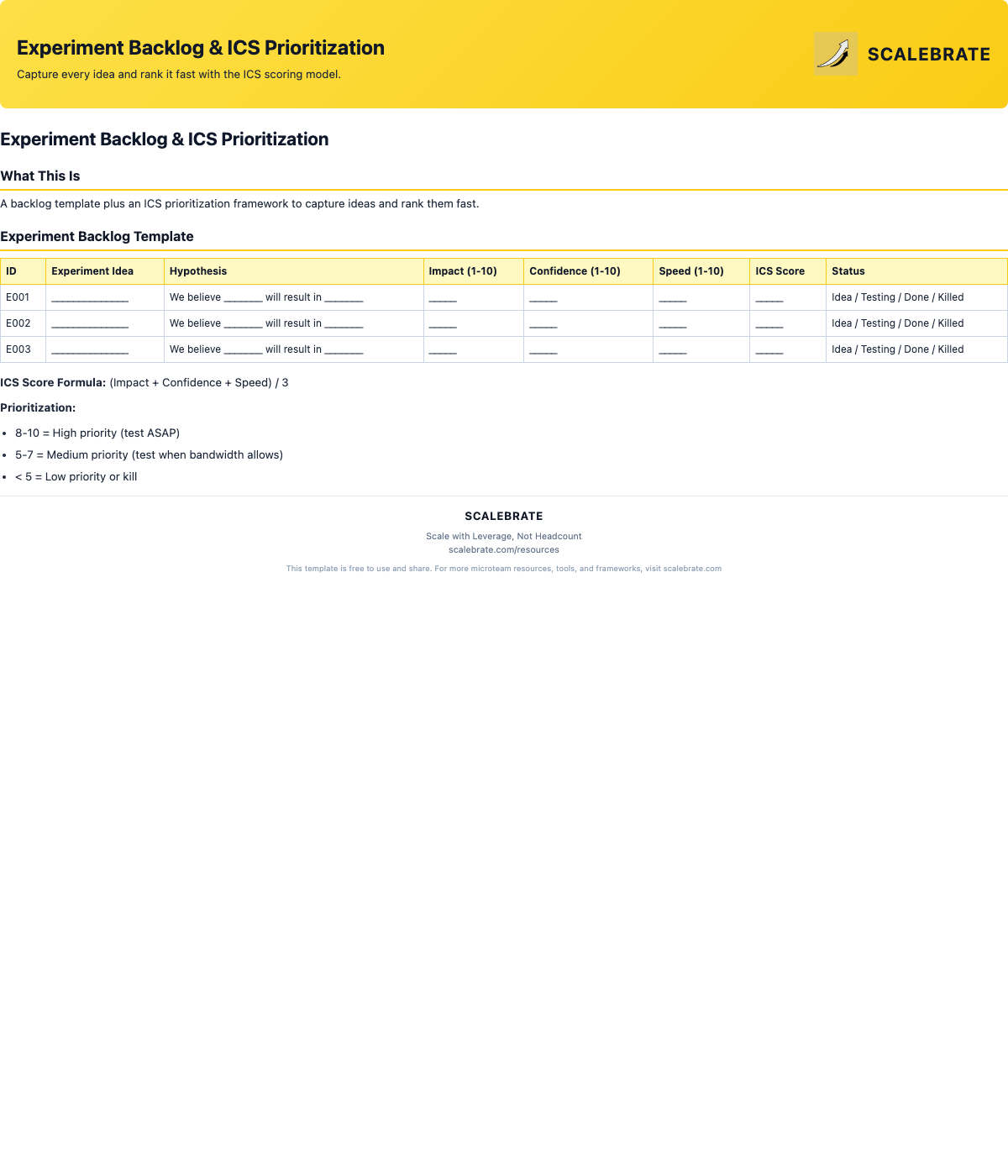
Capture every idea and score it fast with the ICS model.
insightsICS Scoring Guide
Impact (1-10): How much will this move your key metric?
- chevron_right
10 = Could 10x growth
- chevron_right
7 = Meaningful improvement (20-50% gain)
- chevron_right
5 = Modest improvement (10-20% gain)
- chevron_right
3 = Minor improvement (< 10% gain)
- chevron_right
1 = Negligible impact
Confidence (1-10): How sure are you this will work?
- chevron_right
10 = Strong evidence (similar tests, competitor data, clear user demand)
- chevron_right
7 = Moderate evidence (some data, educated guess)
- chevron_right
5 = Weak evidence (theory-based, anecdotal feedback)
- chevron_right
3 = Very uncertain (complete guess)
- chevron_right
1 = Just a hunch
Speed (1-10): How quickly can you test this?
- chevron_right
10 = < 1 day (copy change, simple A/B test)
- chevron_right
7 = 2-3 days (mockup, fake door test)
- chevron_right
5 = 1 week (basic functional version)
- chevron_right
3 = 2-3 weeks (some dev work)
- chevron_right
1 = 4+ weeks (major undertaking)
receipt_longExperiment Results Tracker
Log every experiment to build institutional knowledge.
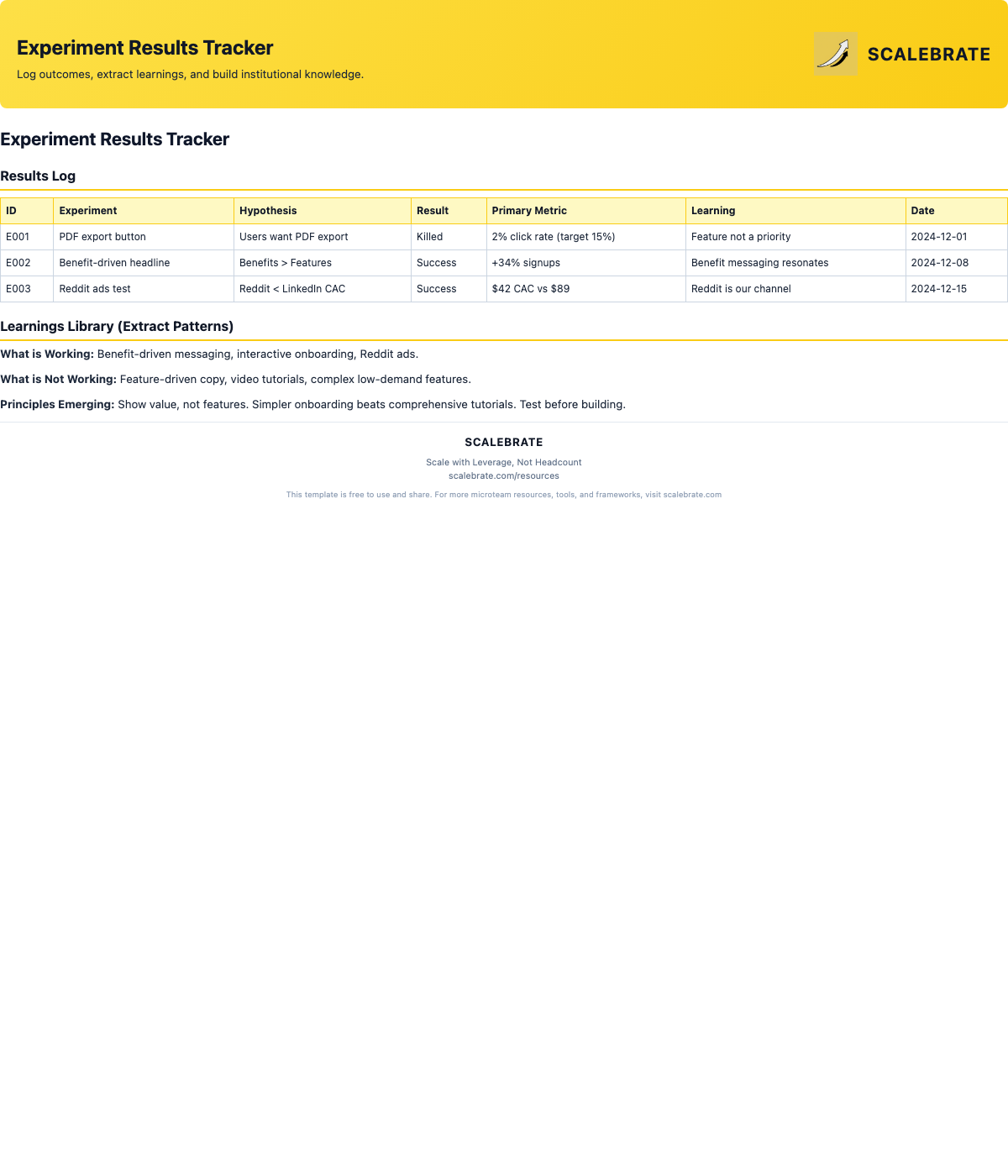
Log outcomes, learnings, and next actions in one place.
scheduleWeekly Experiment Rhythm
Build a habit of shipping experiments every week.
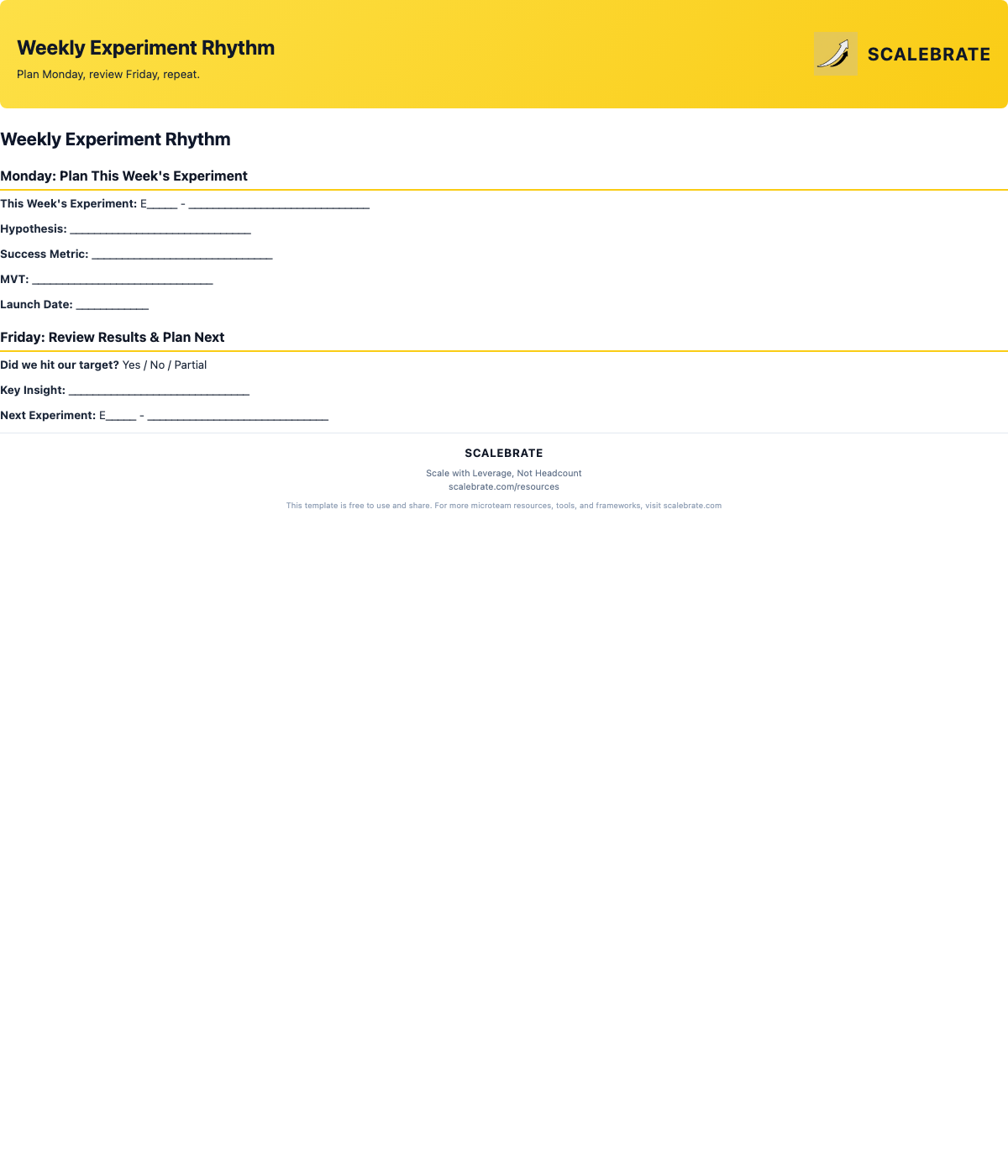
Plan Monday, review Friday, and keep experiments moving.
history_eduExample: How StartupFlow Used This System
Company: StartupFlow (5-person project management tool for startups)
Problem: Roadmap bloat and months wasted on low-value features.
Old Approach: Gantt charts (4% adoption), Slack integration (12%), mobile app (8%). Total wasted effort: 6+ months.
New Approach:
- chevron_right
Week 1: Fake door test for Templates, 42% click rate, build it.
- chevron_right
Week 2: Prototype to 10% of users, 67% usage, ship.
- chevron_right
Week 3: Messaging test, "Start Projects Faster" lifted usage by 28%.
- chevron_right
Week 4: Pricing experiment, $220 MRR from 4 hours of work.
Results After 12 Weeks: 8 experiments shipped, 3 major wins, 5 killed ideas, +$1,200 MRR.
Top Learning: Stop asking "What should we build?" and start asking "What is the fastest way to test this?"
Tip 1: Kill Experiments Ruthlessly - If it is not working after 2 weeks, kill it.
Tip 2: Run One Experiment at a Time - Parallel tests confuse the data.
Tip 3: Celebrate Failures - Failed tests are cheap ways to avoid building the wrong thing.